



SAS Data Engineering
What is SAS Data Engineering?
SAS Data Engineering is a cloud-native data management offering on SAS Viya and includes functions for data integration, data quality, cataloging as well as governance for analytical applications. It is the successor SAS Data Management.
Customer Satisfaction
7.3
★★★★★★★★★★ Rated 7.3 out of 10
User Experience
7.5
★★★★★★★★★★ Rated 7.5 out of 10
Technical Foundation
8.3
★★★★★★★★★★ Rated 8.3 out of 10
Business Value
7.6
★★★★★★★★★★ Rated 7.6 out of 10
About SAS Data Engineering
Self-description of the vendor
No vendor self-description available
About BARC Reviews
Would you like to find out more about BARC reviews? Our FAQs answer the most important questions.
References
No data available
Partners
No data available
SAS Data Engineering BARC Review & Rating
Provider and product description
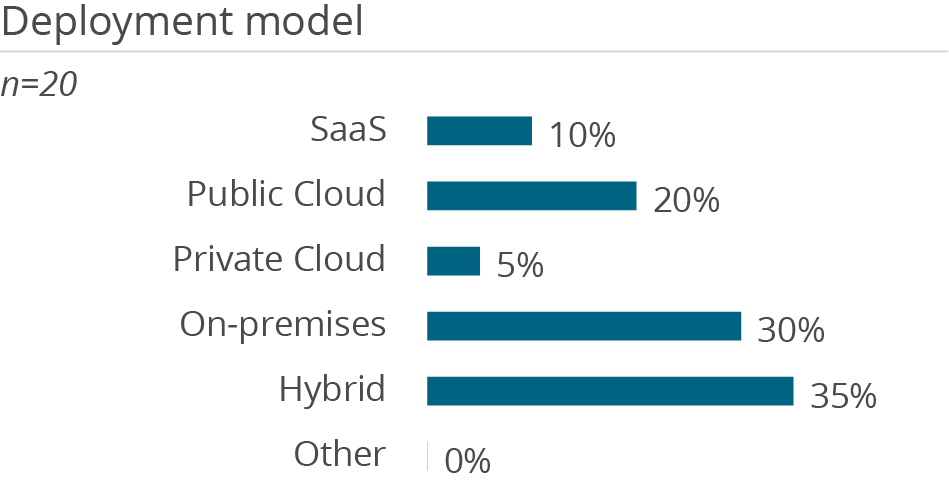
Founded in 1976, SAS has established itself as a global leader in analytics, business intelligence, and data management. The vendor’s data integration and engineering offerings currently serve a diverse user base reflected in the survey’s deployment model results: 30% operate on premises using traditional SAS Data Integration and Data Management, 35% have adopted cloud-based deployments (SaaS, public cloud, or private cloud), and 35% run hybrid environments. This distribution reveals an active platform transition in progress. SAS Data Management represents a comprehensive suite that includes traditional on-premises components such as Data Integration Server and Studio. In contrast, SAS Data Engineering, as part of the cloud-native SAS Viya platform, represents the vendor’s strategic direction. Viya offers an open architecture supporting multiple programming languages including SAS, Python, R, and Lua, marking a significant functional and architectural evolution from the traditional platform. SAS’s guidance to customers reflects this transition strategy: maintain existing SAS 9 and Data Integration Studio installations while planning and executing a gradual migration of data integration workloads to SAS Data Engineering and SAS Studio Flows on Viya.
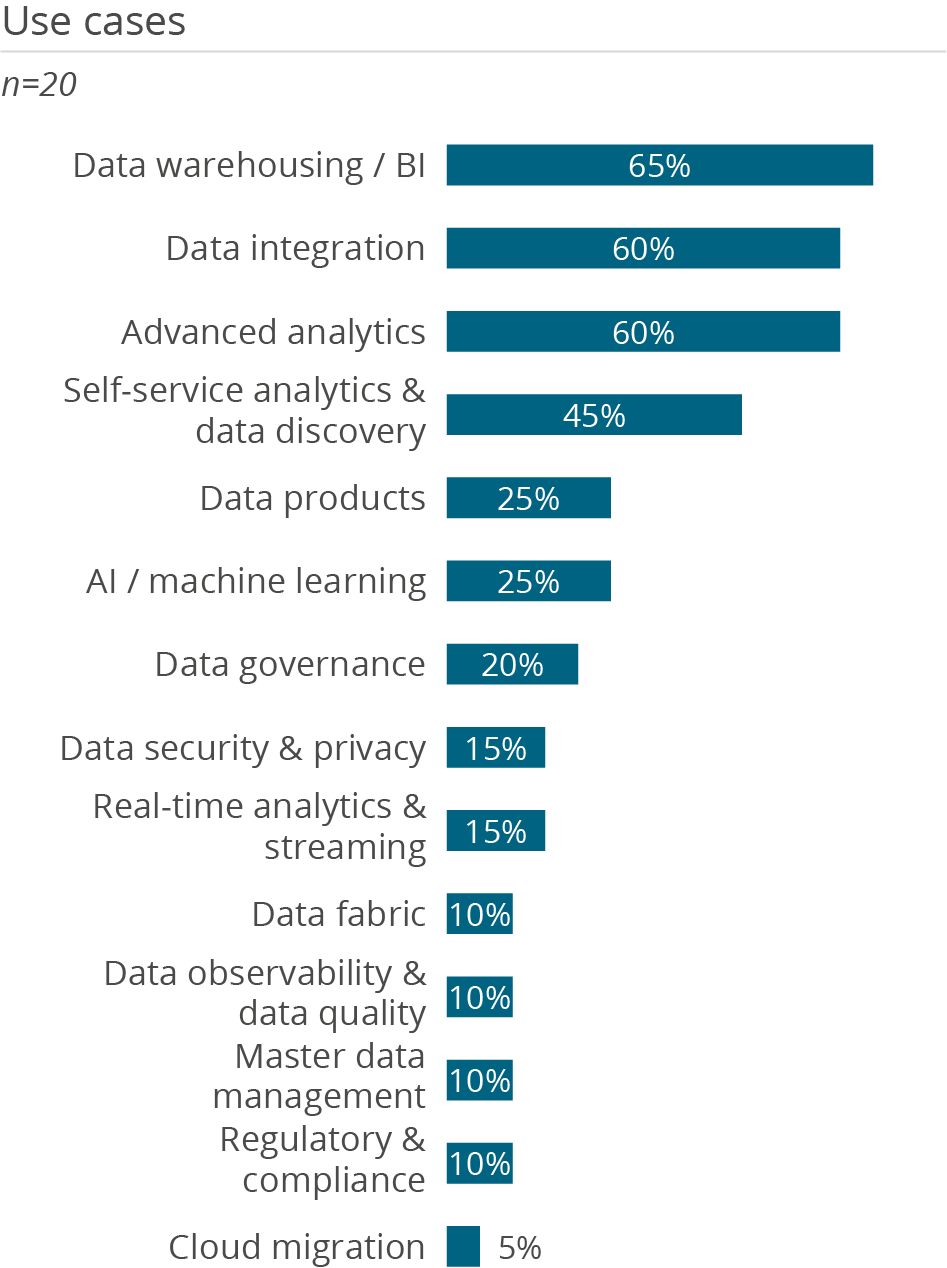
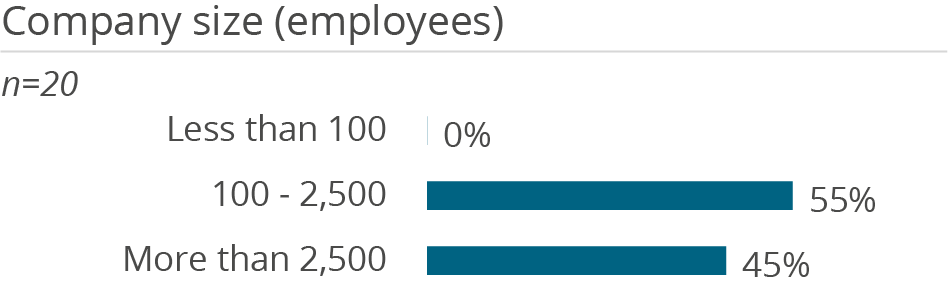
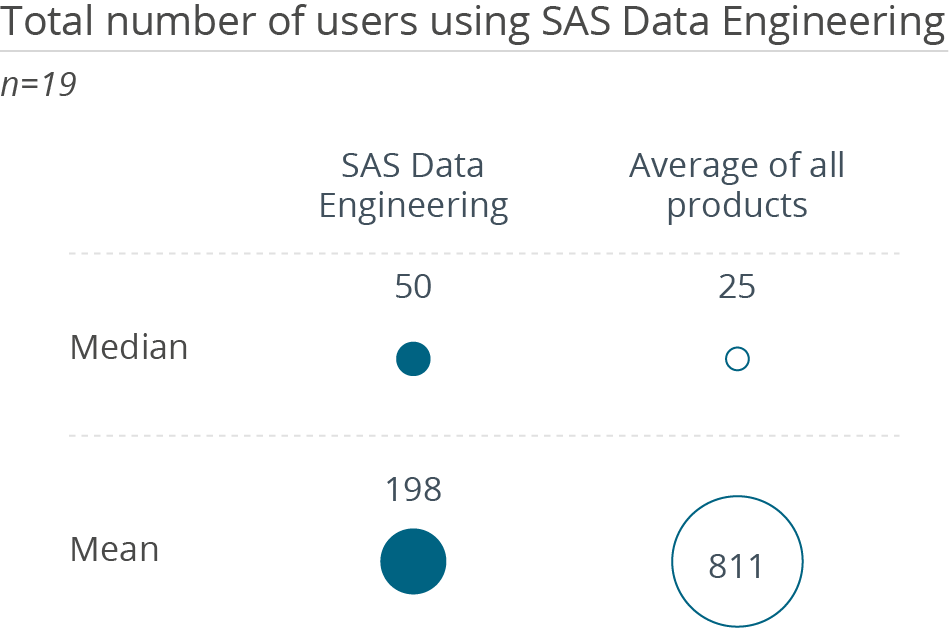
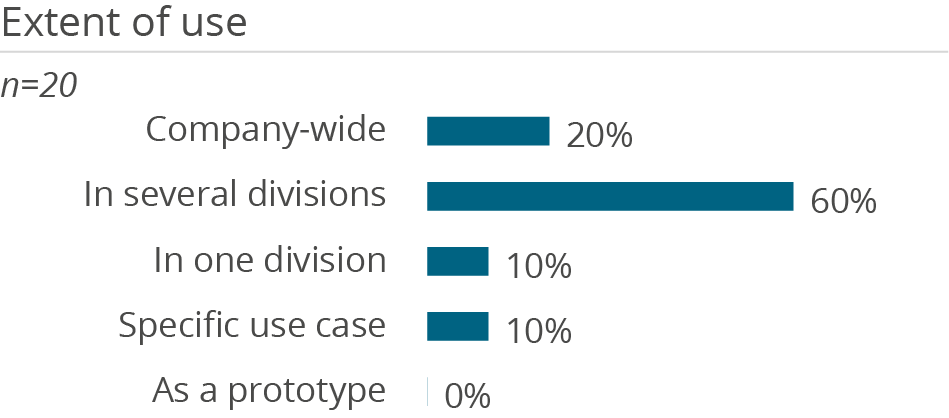
The survey population employs SAS Data Engineering across core use cases including data warehousing and business intelligence (65%), data integration (60%), and advanced analytics (60%). Notably, AI and machine learning adoption has grown from 17% in the 2024 survey to 25% in 2026, a shift attributable to Viya’s enhanced capabilities in this domain. Real-time analytics and streaming use cases have similarly expanded to 15%. The user base shows a median deployment of 50 users with a mean of 198, serving primarily mid-market organizations with 100 to 2,500 employees (55%) and large enterprises exceeding 2,500 employees (45%).
SAS Data Engineering achieved exceptional results in the Data Fabric Survey 26, ranking first in Business Value (7.6/10) and Technical Foundation (8.3/10) across all three peer groups: ETL Tools, Data Engineering Tools, and Data Engineering (Big Players). Within the Technical Foundation category of KPIs, the product captured first-place rankings across all sub-categories, including Platform Reliability (8.5/10), Connectivity (8.5/10), Scalability (8.8/10), and Data Security & Privacy (8.6/10). Ease of Use is also highly rated with a score of 7.9/10, representing a notable differentiator among data engineering solutions from large vendors. Additional strong performance areas include Product Satisfaction (8.5/10), Project Success (8.2/10), and User Support (7.9/10). However, SAS achieved mid-tier rankings for Price to Value (7.0/10) and Time to Market (7.0/10), while Product Enhancements received lower ratings (6.6/10), likely reflecting the maintenance mode status of traditional SAS Data Integration and Data Management components.
Customers cite functional capabilities (60%) and scalability (60%) as primary reasons for selecting SAS Data Engineering, both significantly above the survey average. Reliability (45%), pre-existing vendor relationships (40%), and product roadmap confidence (35%) also score well above average, reflecting both the enduring trust in the traditional SAS 9 platform and growing confidence in Viya’s maturity. An interesting dynamic emerges around platform integration: while customers clearly value SAS’s strong intra-platform integration capabilities – evidenced by the first-place Technical Foundation ranking – concerns about fit into existing technology landscapes (25% versus 44% average) and ecosystem flexibility suggest the proprietary architecture creates external integration challenges.
The most frequently reported problems center on pricing and flexibility. Issues with pricing models and increasing software costs (28% versus 19% average), difficulty in customization and insufficient flexibility (22% versus 8% average), and license model inflexibility (17% versus 7% average) are all cited by an above-average proportion of SAS customers. These concerns align with the lower ratings for price/performance ratio as a buying reason (20% versus 37% average). On a positive note, only 6% of respondents find the tool too difficult for business users, well below the 19% average, reinforcing the platform’s accessibility strength. Additionally, 33% report no significant problems, which is above the 26% average.
SAS demonstrates exceptional technical foundation and business value while navigating a platform transition that presents both opportunities and challenges. The vendor’s strength in business user accessibility and proven reliability is offset by persistent pricing and flexibility concerns.
Strengths and challenges of SAS Data Engineering
BARC’s viewpoint on the product’s strengths and challenges.
Strengths
- First-place ranking in Business Value and Technical Foundation KPIs across all peer groups.
- Exceptional Platform Reliability, Scalability, and Connectivity with top-ranks in these KPIs.
- Strong business user accessibility – a key differentiator versus other data engineering big players.
- Trusted brand with successful gradual migration strategy evidenced by 35% hybrid deployment.
- AI/ML and real-time use case growth driven by Viya capabilities.
Challenges
- Pricing model, flexibility, and license inflexibility concerns consistently reported above average.
- Time-to-market and product enhancement pace lag peer group performance.
- Proprietary architecture creates ecosystem integration challenges despite strong internal integration.
- Price/performance perception needs improvement despite strong technical foundation.
SAS Data Engineering User Reviews & Experiences
The information contained in this section is based on user feedback and actual experience with SAS Data Engineering.
The information and figures are largely drawn from BARC’s The BI & Analytics Survey, The Planning Survey, The Financial Consolidation Survey and The Data Management Survey. You can find out more about these surveys by clicking on the relevant links.
Who uses SAS Data Engineering in a data management context and how
Why users buy SAS Data Engineering and what problems they have using it


Premium content. Unlock with BARC+.
For just €79 per month (€948 per year) you can access all the paid content on www.barc.com.
Your benefits:
- Get independent information on software solutions, market developments and trends in data, analytics, business intelligence, data science and corporate performance management.
- Make data & analytics decisions based on numbers, data, facts and expert knowledge
- Access to all premium articles and all our research, including all software comparison studies, scores and surveys.
- Unlimited access to the BARC media library
- Consume unlimited content anywhere
Full user reviews and KPI results for SAS Data Engineering
All key figures for SAS Data Engineering at a glance.

Premium content. Unlock with BARC+.
For just €79 per month (€948 per year) you can access all the paid content on www.barc.com.
Your benefits:
- Get independent information on software solutions, market developments and trends in data, analytics, business intelligence, data science and corporate performance management.
- Make data & analytics decisions based on numbers, data, facts and expert knowledge
- Access to all premium articles and all our research, including all software comparison studies, scores and surveys.
- Unlimited access to the BARC media library
- Consume unlimited content anywhere
Individual user reviews for SAS Data Engineering
Role
Data engineer/Data manager
Number of employees
100 - 2.500
Industry
Banking and finance
Source
BARC Marketing, Data Fabric 26, 04/2025
What do you like best?
Its ability to handle large-scale data preparation efficiently, with a user-friendly interface and powerful automation tools. It streamlines complex data workflows, making data integration, cleansing, and transformation much easier for teams.
What do you like least/what could be improved?
It can feel a bit heavy or complex for beginners, especially compared to some more modern, lightweight tools. Improvements could include a more intuitive user experience, faster performance for very large datasets, and better integration with open-source tools like Python or Spark.
What key advice would you give to other companies looking to introduce/use the product?
Start with a clear data strategy and invest in training - SAS Data Engineering is powerful, but to get the most from it, your team needs to understand its full capabilities. Also, integrate it with existing systems early on and involve both IT and business users to ensure smooth adoption and real value.
How would you sum up your experience?
SAS Data Engineering is a robust and reliable platform for managing complex data pipelines. It excels in data quality, governance, and scalability, making it a strong choice for enterprise environments - especially where compliance and precision are key. However, it may feel a bit complex for smaller teams or those used to open-source flexibility.
Role
Business analyst
Number of employees
More than 2.500
Industry
Public sector
Source
BARC Marketing, Data Fabric 26, 07/2025
What do you like best?
It is stable and integrates well with a number of data sources.
What do you like least/what could be improved?
It doesn’t feel as mature as previous 9.4 versions (e.g., SAS DI Studio). The concept of metadata is gone, which was really useful for impact analysis, making things more difficult. CI/CD is not easy to integrate, and there is a lack of plain-text change control.
What key advice would you give to other companies looking to introduce/use the product?
Check your requirements and try to keep things in-house.
How would you sum up your experience?
It is good; I hope it matures more over time.
Survey Information
Number of reviews for SAS Data Engineering
20
Reviewed versions
Peer groups in the survey
Data Engineering Tools, Data Engineering (Big Players), ETL Tools
